
When was the last time you remember clicking page 2 on a Google search? What was that, you can’t remember? Me either! And that’s thanks to Google’s amazing and ever so technical search engine algorithm. More often than not, the answers we are looking for are found within the first page of a Google Search!
So how does Google figure out what should be shown on the first page of a Google Search?
METHOD 1: SEARCH ENGING OPTIMISATION:
Nobody can give all the exact reasons to determine how Google’s algorithm works given there are over 200 factors that determine where a web page will rank in a google search, however here are a few factors known to contribute to the ranking:
- Frequency of keywords within a page – How many times do the keywords in the search appear within the web page? Does the page include synonyms for keywords?
- Location of keywords within a page – Are the search terms only in the body of the page? the title of the page? the URL?
- Quality of web page? – Is the web page of a high quality? Or is it ‘spammy?’
- Number of other site that link to the page – are there a number of high quality web pages linking to one particular page?
These factors with over 195 more factors contribute to the overall rank of a page which then determines where it will appear on a Google search.
For example, if I typed in a Google search ‘black top’ here are my results:
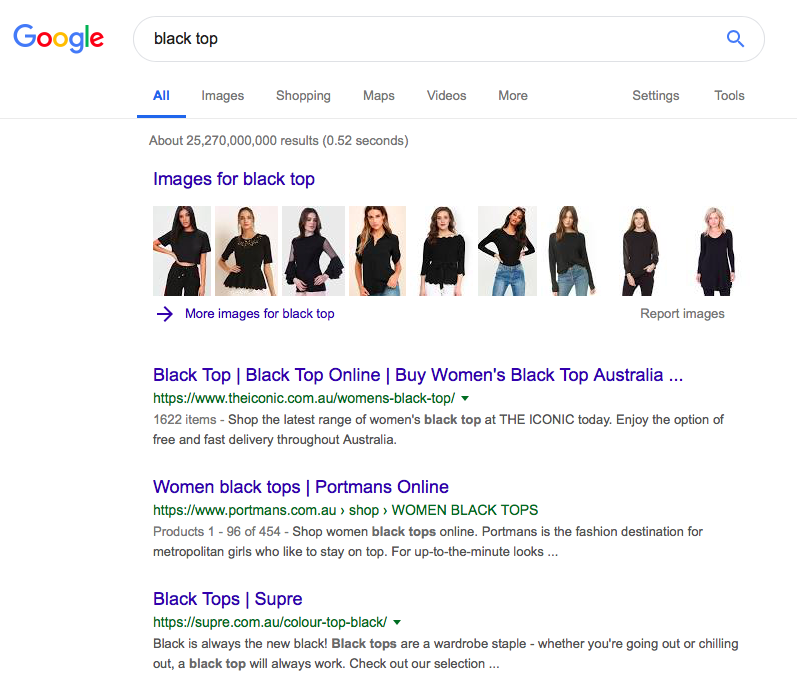
These listings are what’s known as organic listings because they naturally appear on a Google search.
METHOD 2: PAID SEARCH MARKETING
Google offers sponsored posts that work in a similar way to the above, however, brands pay Google to show the webpage as the top search result when certain keywords are searched. For example, If I type in Google ‘inexpensive curtains’, here is what is shown on my Google search:
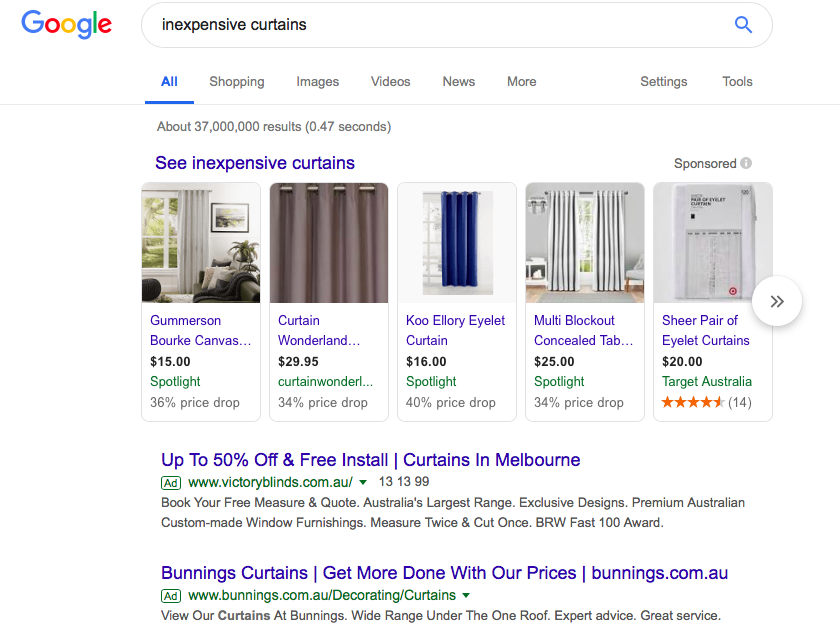
As you can see above, Google has displayed 3 different sponsored posts which can be recognised by the green AD written next to the websites URL. Google is very transparent with paid advertisements and will always tell you if a page is sponsored or not.
These posts are often Paid Per Click (PPC) which means that a brand will only pay for the advertisement when its clicked on.
You can watch this video for a short explanation on how Google search works:
So what should brands do to optimise their search engine rank!?
This article discusses 2 approaches to improve search engine rank; the black hat approach and the white hat approach .
Black Hat Approach –
Known as the quick fix method which involves undertaking actions which provide short term gain but not so much in the long term. This involves action such as
- link farms (pages which only list links)
- keyword stuffing (listing keywords somewhere on a page)
- blog comment spam (automated comments linking to a website)
If Google detects these black hat tactics, the site will be negatively effected in the long run!
White Hat Approach –
The better approach which takes longer to implement and see results, however yields long term results and follows the rules! This includes
- link baiting (informative and useful links to your page)
- quality content (content that is well researched and your visitors look to find)
- internal linking (guiding visitors through relevant links internally)
These methods put the user at the heart of its content and will eventually see results in their SEO strategy!
What are your thoughts on SEM?
 Talking Tech with Bec
Nice post! It’s interesting to see how efficient Google has become in providing the search results that are most prevalent to what you have typed in. I think the best way to go about SEM is through using SEO instead of PPC. I find that I rarely click on the PPC results as they don’t appear to be as legitimate even though they might be.
LikeLike
Thanks for reading! I totally agree, to be honesty even if the website is the same, I naturally click on the link that isn’t the ad. It’s funny how we’ve conditioned to act this way!
LikeLike
I find it interesting when the brand at the top of the organic listings is the same as the top PPC advertisement when I conduct a search – especially when so many people distrust the top Ad Listing! Do you think this is just to maximise traffic on their site? Why bother paying when you’re already at the top.
LikeLike
I agree, I find it very interesting when the PPC post and the organic listing is the same. To be honest in these cases I naturally click the organic search result because of the stigma that advertisements were paid to be there and hence not useful.
However, I definitely think it is to maximise traffic to their website and almost guarantee clicks. Although, it is worth noting that Google may consider your cookies and google account etc. to tailor search results for each individual person, so potentially the first organic listing may not always be the same as the PPC advertisement. I guess brands undertake a PPC strategy to ensure their page is shown for everybody.
Another consideration would be that the top ranking listing in an organic search wasn’t always the top listing, but through continued clicks on the PPC advertisement, the page increased in ranking!
Does this make sense?
LikeLike
Awesome post Bec – definitely some insightful points in here.
I came across an article the other day that spoke about how everyone’s page 1 results are different because they’ve got different cookies/IDs, so if I were to search for black top, it’d most likely direct me towards men’s clothing and any brands I’ve been to before, compared to your search which was women’s tops. I think if a brand could create high interest for themselves and have consumers reach their website, they’d be more likely to show up. It’s a bit roundabout but I hope it makes sense!
LikeLike
Thanks Ruben, I’m glad you enjoyed the post!
I have heard that Google does tailor their search results depending on the user! For example, have you ever tried searching using the ‘near me’ me feature? (For example, restaurants near me). Google uses your location to tailor search results! Very smart indeed… when Google gets it right…. Google thought a friend of mine was always in London when in fact she was in Melbourne!
LikeLiked by 1 person
Very interesting post bec! I think SEO honestly makes life so much easier and cuts down time spent searching when there is a tailored answer provided to you! But yes google doesn’t always get it right and still thinks I’m in the UK so that’s annoying and I find myself getting really frustrated when searching for places near me because I expect it to know my location. So it’s not yet perfect, I still need to fix the location thing.
Have you ever had issues with google getting your SEO wrong?
LikeLike
Thank you, I’m glad you enjoyed it!
SEO definitely does cut down a lot of time. It also improves the content available on the web because as sites try to improve their ranking, they’re increasing the relevance and quality of their website which ultimately helps users. Win win!
I’ve never really had any issues personally!
LikeLike